
Sophie O’Connell, Partner, Wilsons Solicitors and Rosie Harding, Professor of Law and Society, Birmingham Law School, University of Birmingham
In this article, we share the lessons we have learned from the CLARiTY (Capacity ,Law and Rights Information to You) and COALITION (Co-Producing Accessible Legal Information) projects. We ran these projects with Philippa Bragman OBE, consultant facilitator. Bringing Us Together, a community interest company for disabled children, young people and their families worked with us on CLARiTY and People First worked with us on COALITION. More detailed information about the projects can be found at www.legalcapacity.org.uk.
Accessible information is vital to removing barriers that prevent disabled people from fully participating in society. It is already promoted by a range of national, international and service specific legal frameworks, including the Equality Act 2010; UN Convention on the Rights of Persons with Disabilities; Health and Social Care Accessible Information Standard; and Public Sector Bodies (Websites and Mobile Applications) Accessibility Regulations 2018. The Equality Act 2010 is the most important for private service providers as it sets out a duty to provide accessible information. Section 20 (6) expressly includes ensuring that ‘information is provided in an accessible format’ in the anticipatory duty for service providers. Importantly, service providers cannot charge the disabled person to pay any of the cost of complying with the duty. Just as law firms need to ensure their buildings are accessible, they must consider what adjustments are needed to make the legal information they provide accessible.
In our projects we discovered that improving access to legal services needs more than accessible information, writing in plain English or producing easy read documents (though these are also very important). Connecting and communicating are also vital, because there are very real power differentials in the relationship between professional deputies and clients, which can themselves act as barriers to justice. Members of the People with Learning Disabilities COVID-19 Support and Action Group who attended the CLARiTY sessions told us: ‘We have learning disabilities and we want to explain to you the different ways we communicate and what helps us. Instead of talking at us in legal jargon, talk to us in everyday language we can understand.’
As deputies, our role is to support clients to understand what we are communicating, if we fail to do that, we have to try harder to succeed. It is also important to recognise what can be at stake for a disabled person when they say they don’t understand: it can lead to capacity assessments, greater interference in their privacy and ultimately losing control of important decisions in their lives.
From our work on the CLARiTY and COALITION projects, our top tips for building rapport to improve access to legal services are:
-
- recognise your power and privilege;
-
- use stories to put complicated legal ideas into relatable contexts;
-
- be warm, friendly and approachable;
-
- use straightforward language and avoid jargon; and
-
- don’t be afraid to ask if you are being clear enough.
The COALITION project brought together a co-production group of people with learning disabilities and legal professionals to explore barriers to access to legal services for people with learning disabilities, and to investigate how legal services could be made more accessible to disabled people with cognitive impairments. The project found that people with learning disabilities experience barriers to access to justice at every stage of seeking advice about a legal problem. This includes difficulties in accessing general information about law that can help them identify when to seek legal advice, difficulties in accessing legal services and choosing the right service provider, understanding complex terms of business and ‘client care’ letters, and in understanding legal jargon when they do receive legal advice and services. People with learning disabilities have a high level of unmet legal need which can be addressed by the development of high quality accessible legal information on a range of different topics. While the project involved people with learning disabilities it can be assumed that all of our clients will experience similar difficulties accessing legal services. The full COALITION project report can be found at: Making Legal Services More Accessible.
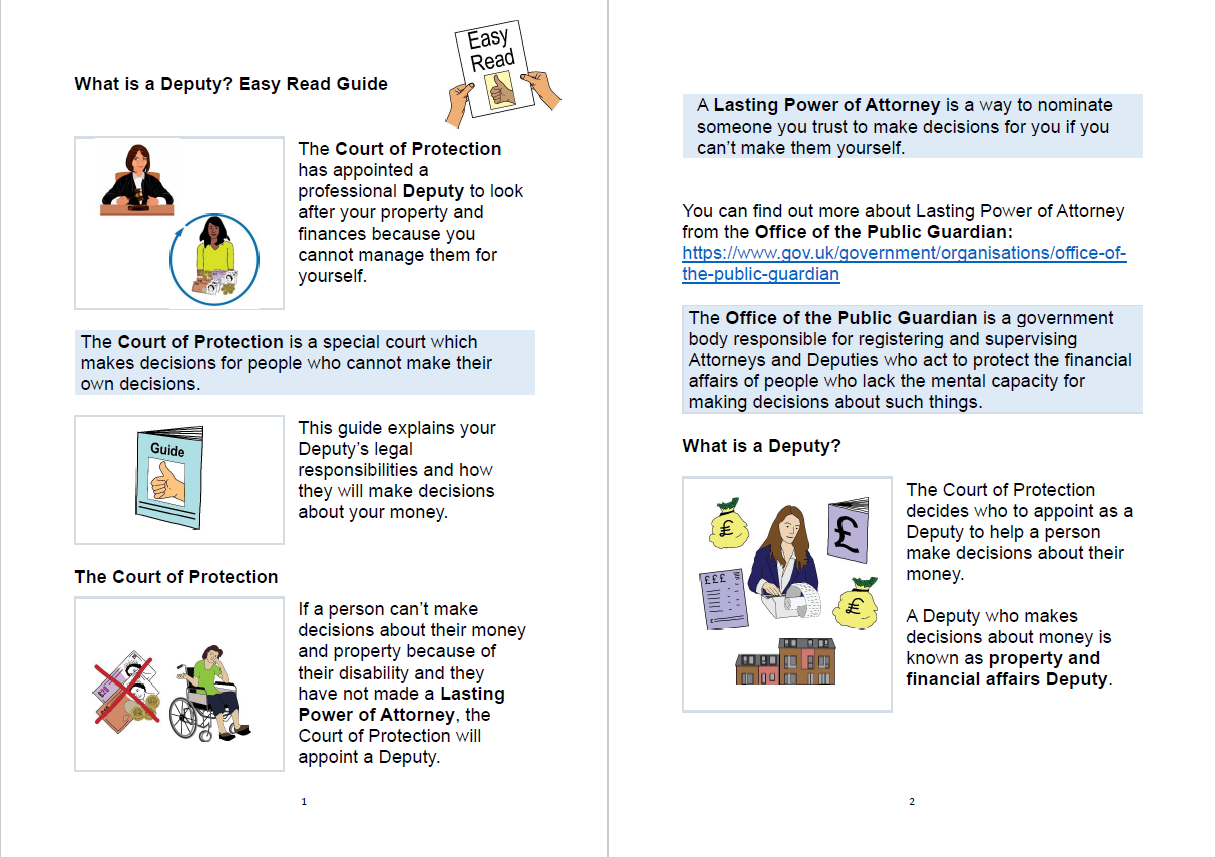
The project co-produced a set of template materials aimed at supporting professional deputies to explain the work they do to their clients as well as an easy read letter of agreement. The COALITION Templates include:
- An easy read guide to what a property and financial affairs deputy can do.
- A template ‘letter of engagement’ which sets out the kind of information that would usually be found in a client care letter.
- An easy read letter that professional deputies can use to introduce themselves and the service they provide.
A lot of the legal professionals involved in the project worked within the remit of the Mental Capacity Act 2005 (‘MCA’) but often did not consider that they had obligations to provide accessible legal information to the individual themselves, preferring to communicate via family members. However, mental capacity law and Court of Protection practice covers such fundamental areas of people’s lives that access to information about what is going on is really key to inclusive and successful legal support and access to justice.
The disabled participants in the project were very clear that they would always want to have some kind of written reference material that they could look at as a reminder of what the solicitor has said and what they can do for them.
You can access and download our legal services templates through the MICRA gateway platform. [https://licensing.micragateway.org/product/legal-services-templates]
These documents are available as digital downloads for legal service providers to use and adapt. They are provided as a training resource for legal service providers and a guide to increasing the accessibility of legal information. These resources do not constitute legal advice.
Sophie O’Connell, Partner at Wilsons Solicitors reflects on her experience of using the COALITION templates:
“I have found that the information about ‘what is deputy?’ and especially the easy read guide has been very useful when making deputyship applications, to help explain the role of the role of the deputy to a client and as part of the notification process. This document is also useful for family members, who are usually going through a very stressful time and if their loved one has an acquired brain injury, they are likely to be overwhelmed with information from the personal injury solicitor, medical professionals, therapists and now the proposed deputy. Understandably, clients and their families are often fearful about the perceived ‘control’ and ‘interference’ that a deputy could have in their lives. They will not usually know the strict rules that deputies have to adhere to and the important focus on support and not control in the Mental Capacity Act 2005.
Another document from the COALITION Templates which I have found useful is the easy read letter introducing the deputy which can be tailored to add your picture and the details of anyone else working for the client. It is not a long document, and I often send a copy to be included in a client’s brain injury book or other type of reference tool for those working for them. There can be a lot of people involved in brain injury care and case management if there is a multi-disciplinary team and it is really important for the client to know who is looking after their money!”
The COALITION Project legal services templates are completely free, and distributed under a CC-BY license. We only ask that you register your interest in the templates to access them. We would also like you to provide some contact information so that we can collect feedback about your use of the toolkit.
Sophie O’Connell, Partner, Wilsons Solicitors and Rosie Harding, Professor of Law and Society, Birmingham Law School, University of Birmingham